










































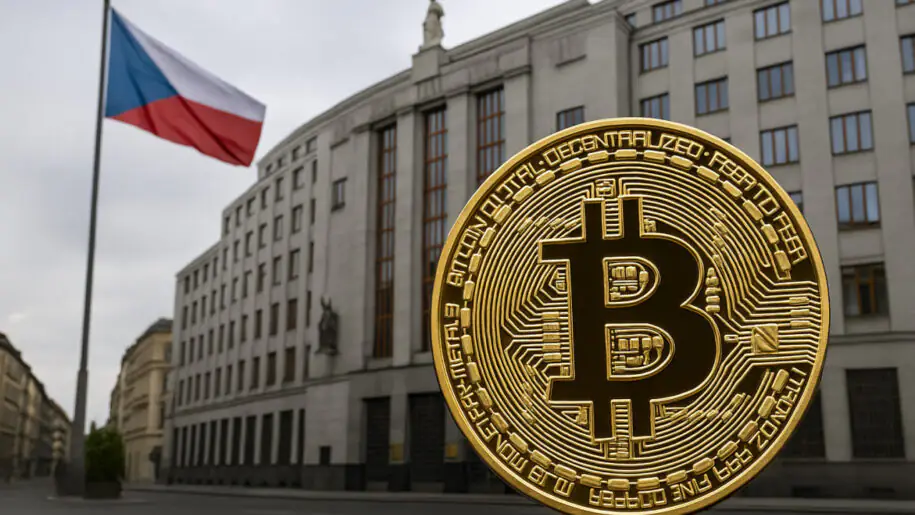
Pioneering Digital Reserves: CNB’s Bold Experiment in Blockchain
In a groundbreaking step for central banking and cryptocurrency integration, the Czech National Bank (CNB) announced on November 13, 2025, that it has purchased $1 million worth of digital assets for the first time in its history. This test portfolio, held outside the bank’s international reserves, primarily consists of Bitcoin (BTC), alongside a U.S. dollar-pegged stablecoin and a tokenized deposit, marking Europe’s inaugural instance of a central bank directly acquiring cryptocurrencies for operational evaluation. The initiative, approved by the CNB’s Bank Board on October 30, 2025, aims to provide hands-on experience with blockchain-based assets amid rapid technological evolution, without altering the bank’s core monetary policy or reserve strategy.
CNB Governor Aleš Michl, who first proposed the idea in January 2025, emphasized the experiment’s forward-looking intent: “We want to test this path” for emerging payment and investment innovations, while reaffirming the bank’s commitment to low inflation and koruna stability. This modest $1 million allocation—tiny against the CNB’s $602.94 billion reserves—serves as a controlled pilot to assess operational feasibility, from custody and key management to AML compliance and crisis scenarios, with results to be evaluated in 2-3 years. In a $3.57 trillion crypto market stabilizing post the recent U.S. shutdown, this move signals Europe’s cautious embrace of digital assets, potentially influencing peers amid stablecoin volumes at $19.4 billion YTD and institutional BTC absorption of 300K tokens.
The Portfolio Breakdown: BTC, Stablecoins, and Tokenized Assets
The CNB’s test holdings are deliberately diversified to benchmark traditional crypto against fiat-pegged alternatives, enabling comprehensive analysis of risks and benefits:
| Asset Type | Allocation Focus | Purpose | Key Features Tested |
|---|---|---|---|
| Bitcoin (BTC) | Majority (~70-80%) | Decentralized store of value | Custody, volatility management, AML verification |
| USD Stablecoin (e.g., USDC/USDT) | ~15-20% | Pegged digital cash | Redemption, on-ramp/off-ramp efficiency, regulatory compliance |
| Tokenized Deposit | ~5-10% | Hybrid fiat-blockchain | Accounting, auditing, multi-level approvals |
The portfolio’s composition allows the CNB to compare decentralized (BTC) vs. centralized (stablecoin) and hybrid models, with ongoing transactions to simulate real-world operations. While the value may fluctuate with market prices, the CNB plans no active expansion, focusing on internal processes like key administration and security mechanisms.
Strategic Drivers: Independence, Innovation, and Global Context
The Czech Republic’s non-adoption of the euro grants the CNB unique autonomy within the Eurosystem, allowing this experiment without ECB oversight—unlike eurozone peers bound by stricter mandates. Governor Michl’s January 2025 proposal stemmed from an internal analysis of digital assets’ growing acceptance among funds and corporations, aiming to future-proof the bank’s toolkit for payments and reserves. The pilot tests the “whole chain” of processes, from purchase to AML verification, without policy implications for the koruna or inflation targets.
Globally, this aligns with a wave of central bank curiosity: The U.S. Strategic Bitcoin Reserve holds $17 billion in forfeited BTC, El Salvador treats it as legal tender, and Taiwan evaluates reserves. In Europe, the ECB focuses on a digital euro CBDC, but national banks like the CNB push boundaries for blockchain insights. X sentiment is electric: “CNB’s $1M BTC buy? Europe’s central banks waking up—Sats to reserves!” one post exclaimed, with #CNBCrypto trending regionally.
Broader Implications: A Template for Crypto in Central Banking
This pilot could catalyze European adoption: By sharing findings in 2-3 years, the CNB may influence ECB policies on digital assets, bridging fiat and blockchain for payments innovation. Risks include volatility (BTC’s 1.58% annualized) and custody challenges, but the small scale mitigates exposure. For crypto markets, it’s bullish: Sovereign interest reinforces BTC’s reserve narrative, potentially adding $30 billion in demand if emulated regionally.
In a year of ETF milestones ($70B AUM) and stablecoin surges, the CNB’s $1M test isn’t just an experiment—it’s Europe’s first step toward a blockchain-balanced ledger. As Michl affirmed, “New ways of paying and investing will emerge rapidly.” The koruna may hold steady, but crypto’s central bank era has begun.