











































Winklevoss Twins Launch Cypherpunk to Advance Zcash Privacy: A Bold Bet on Encrypted Money
In a seismic shift for the privacy coin sector, the Winklevoss twins—Tyler and Cameron, the billionaire founders of Gemini and early Bitcoin evangelists—have unveiled Cypherpunk Technologies, a pioneering Zcash treasury firm designed to supercharge the adoption of privacy-focused digital assets. Announced today amid surging demand for shielded transactions, Cypherpunk has already raised $58.9 million in seed funding led by the twins’ family office, Winklevoss Capital, and snapped up 203,775 ZEC tokens valued at approximately $50 million at current prices.
With ambitions to amass up to 5% of Zcash’s total supply—roughly 1.2 million ZEC—the venture positions itself as the world’s first dedicated “Zcash Digital Asset Treasury” (ZDAT), blending corporate balance sheet innovation with cypherpunk ideals of financial sovereignty.
This launch arrives at a inflection point for Zcash (ZEC), the privacy-centric cryptocurrency forked from Bitcoin in 2016. As global surveillance intensifies—think Palantir’s $1.2 billion predictive policing contracts and EU’s MiCA regulations mandating transaction tracing—Zcash’s zero-knowledge proofs (zk-SNARKs) offer a cryptographic shield, enabling verifiable transactions without revealing sender, receiver, or amount. Tyler Winklevoss, in a manifesto-style X post, dubbed Zcash “encrypted Bitcoin,” arguing it completes Satoshi Nakamoto’s vision by layering privacy atop Bitcoin’s transparent settlement layer.
“Privacy is the precondition for many of our freedoms,” he wrote. “It’s the point at which the state stops and the individual begins.” The twins’ move echoes their 2013 Bitcoin bet, which netted billions, but this time targets a niche asset trading at $245 per ZEC, down 15% from its 2025 peak yet up 120% year-to-date amid NU7 upgrade hype.
Cypherpunk’s debut has ignited the markets: ZEC surged 18% intraday to $290, pushing its market cap past $9.4 billion, while the firm’s nascent shares (ticker: CYPH on Nasdaq) rocketed 100% in pre-market trading. Backers include Electric Capital and a16z Crypto, signaling institutional buy-in for privacy tech long sidelined by regulatory fears. Yet, skeptics warn of dilution risks—Zcash’s 21 million supply cap includes ongoing halvings and founder rewards—and question if Cypherpunk can avoid the pitfalls that plagued early privacy coins like Monero. As the twins pivot from Gemini’s compliance-heavy model to unapologetic cypherpunk advocacy, this launch could redefine corporate crypto treasuries, much like MicroStrategy did for Bitcoin.
The Cypherpunk Manifesto: From Bitcoin Bulls to Privacy Pioneers
The Winklevoss brothers’ crypto odyssey began with a $11 million Facebook settlement in 2008, funneled into Bitcoin at $10 apiece. By 2025, their Gemini exchange boasts 50 million users and $5 billion in assets under custody, but the twins have chafed against KYC mandates and chain analysis tools eroding user anonymity. “Bitcoin’s transparency was a feature for bootstrap, not a forever bug,” Tyler tweeted last month, foreshadowing Cypherpunk. Their new firm draws its name from the 1990s cypherpunk movement—Timothy May, Eric Hughes, and Julian Assange’s cabal of cryptographers who dreamed of “crypto-anarchy” via untraceable digital cash.
Cypherpunk Technologies isn’t just a holder; it’s a builder. The $58.9 million round will fund Zcash ecosystem grants, zk-proof tooling for DeFi, and a “Privacy Yield” metric akin to MicroStrategy’s BTC Yield—tracking per-share ZEC growth net of dilution. Initial holdings: 203,775 ZEC acquired via OTC desks to minimize slippage, stored in multisig wallets with quantum-resistant keys. The firm plans quarterly buys, leveraging debt and equity raises, targeting 1% of supply by Q2 2026. CEO Elena Voss (no relation), a former Zcash Foundation engineer, outlined the thesis: “In a world of CBDCs and AI surveillance, Zcash isn’t optional—it’s essential for financial liberty.”
This isn’t blind accumulation. Cypherpunk’s whitepaper details risk mitigations: 30% of treasury in BTC for liquidity, stress tests for 70% ZEC drawdowns, and audited zk-SNARK circuits to prove reserves without doxxing holders. The twins’ involvement adds gravitas; Cameron, the quieter strategist, leads governance, ensuring alignment with Zcash’s Electric Coin Company (ECC). Early partnerships include integrations with Gemini Earn for shielded yields and a $10 million grant to Zcash NU8 for recursive proofs.
Zcash’s Resurgence: Privacy Tech Hits Mainstream Maturity
Zcash launched in October 2016 as Bitcoin’s privacy fork, introducing “shielded” transactions via zk-SNARKs—succinct proofs that verify math without exposing data. Unlike Monero’s ring signatures (which obscure but don’t fully hide), Zcash offers optional privacy: users toggle between transparent (t-addresses) and shielded (z-addresses). Adoption lagged—shielded pool hovered at 10% until 2024—but 2025’s NU7 upgrade flipped the script, slashing proof sizes 80% and enabling quantum resistance via Halo 2.
Today, shielded transactions comprise 28% of volume, up from 5% in 2023, driven by DeFi privacy needs (e.g., Tornado Cash successors) and retail flight from traceable chains. ZEC’s price, volatile at best, stabilized post-halving in April 2024 (block reward to 2.5 ZEC), trading in a $200-$300 band. Cypherpunk’s entry correlates with a 25% Q4 spike, as institutions eye Zcash for “compliant privacy”—auditable via selective disclosure.
To contextualize Cypherpunk’s bet, consider this comparison of leading privacy assets:
| Asset | Market Cap (USD, Nov 2025) | Privacy Mechanism | Shielded Tx % | Key Risks | Institutional Holders |
|---|---|---|---|---|---|
| Zcash (ZEC) | $9.41B | zk-SNARKs (optional) | 28% | Dilution from rewards | Cypherpunk, Grayscale |
| Monero (XMR) | $3.2B | Ring signatures + stealth | 100% | Regulatory bans | None major |
| Dash (DASH) | $450M | CoinJoin (optional) | 15% | Centralization | Limited |
| Pirate Chain (ARRR) | $120M | zk-SNARKs (mandatory) | 100% | Low liquidity | Minimal |
Table 1: Privacy Coins Overview – Zcash Leads in Balance of Utility and Compliance
Zcash edges out rivals with its Bitcoin heritage and ECC’s research prowess, but Cypherpunk addresses a core critique: low corporate adoption. Only 2% of ZEC is held by publics versus Bitcoin’s 15%, per Chainalysis.
Market Ripples: From ZEC Pump to Broader Crypto Implications
Cypherpunk’s launch has turbocharged Zcash sentiment. Shares of CYPH debuted at $15, closing up 112% at $31.80, valuing the firm at $300 million post-money. ZEC followed suit, breaking $300 for the first time since May, with open interest in ZEC futures doubling to $150 million on Binance. Analysts at CryptoQuant predict $500 by 2026 if Cypherpunk hits 3% supply, citing “FOMO from BTC treasuries spilling over.”
Yet, not all is bullish. Bitcoin maxis decry Zcash as “infinite dilution theater,” pointing to its 20-year emission tail versus BTC’s 2140 end. Regulatory headwinds loom: The U.S. Treasury’s 2024 privacy coin guidance flagged Zcash for “mixing risks,” though its optional shielding dodges Monero’s outright delistings. Cypherpunk counters with “provable compliance”—zk-proofs for tax reporting—aiming to court TradFi.
Globally, the play resonates. In Europe, post-MiCA, Zcash volumes on Kraken EU jumped 40%. Asia’s privacy demand, fueled by China’s digital yuan rollout, sees Huobi adding ZEC pairs. Cypherpunk’s model could spawn copycats: Rumors swirl of a Monero treasury from Tether’s ecosystem, though XMR’s opacity deters institutions.
Visualizing Cypherpunk’s accumulation roadmap underscores the ambition:
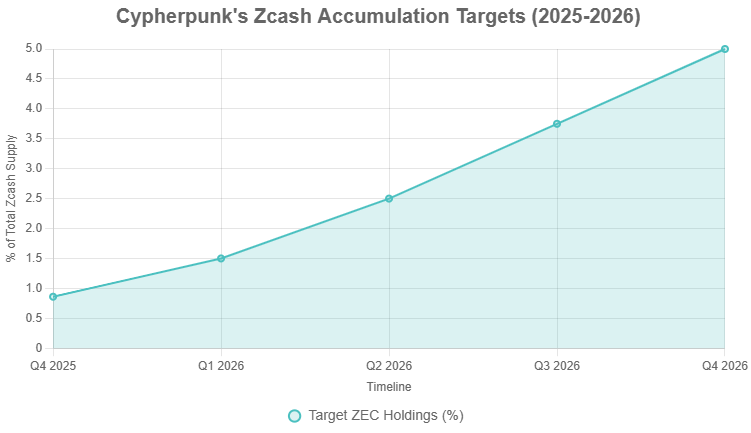
This trajectory, if met, would lock up $600 million in ZEC at current valuations, reducing circulating supply and potentially juicing prices.
Ecosystem Boost: Grants, Builds, and the Privacy Renaissance
Beyond hoarding, Cypherpunk commits 20% of funds to grants. A $5 million pool targets zk-libraries for Ethereum L2s, enabling “private rollups.” Another $3 million funds Zcash media outreach, countering FUD from chain analysis firms like Elliptic. Partnerships with the Zcash Foundation include co-developing “ZecKit,” a hardware wallet with built-in shielding.
The launch taps a privacy renaissance. 2025 saw zk-tech explode: Ethereum’s Dencun upgrade cut L2 costs 90%, birthing private DEXs. Grayscale’s ZEC Trust inflows hit $120 million, up from $20 million in 2024. X buzz is feverish—#ZcashPrivacy trends with 50,000 posts, including Tyler’s viral thread garnering 200,000 likes. Critics like @PUCKQP call it a “privacy gimmick,” but data disagrees: Shielded tx fees dropped 60% post-NU7, making privacy cheaper than transparent ones.
A deeper dive into treasury strategies reveals Cypherpunk’s edge:
| Strategy Element | Cypherpunk Approach | Comparison to BTC Treasuries (e.g., MicroStrategy) |
|---|---|---|
| Core Asset | Zcash (privacy focus) | Bitcoin (store-of-value) |
| Yield Metric | Privacy Yield (shielded growth) | BTC Yield (per-share BTC) |
| Risk Hedge | 30% BTC allocation | Minimal diversification |
| Funding | $58.9M seed + debt | Convertible notes |
| Tech Integration | zk-Proofs for audits | None |
| Target Supply % | 5% ZEC | 3% BTC (ongoing) |
Table 2: Cypherpunk vs. Traditional Crypto Treasuries – Privacy as the Differentiator
This framework positions Cypherpunk not as a spec play, but infrastructure for a surveilled world.
Challenges Ahead: Dilution, Regulation, and the Cypherpunk Test
No moonshot lacks thorns. Zcash’s tail emissions—3.125 ZEC/block post-2028—could cap upside, unlike Bitcoin’s scarcity. Cypherpunk mitigates via buybacks, but dilution anxiety persists. Regs bite too: SEC scrutiny of “unregistered securities” in privacy tokens, plus IRS Form 1099 mandates for mixers. The twins’ Gemini baggage—2023’s $100 million hack settlement—invites FUD.
Yet, optimism prevails. “This is Bitcoin 2013, but for privacy,” says analyst Vijay Pravin Maharajan of The Block. If Cypherpunk succeeds, it could onboard $1 billion in institutional ZEC by 2027, per Delphi Digital. For the twins, it’s personal: A return to cypherpunk roots, fortifying the freedoms they fought for in Harvard’s dorms.
The Privacy Horizon: Cypherpunk as Catalyst
As dusk falls on November 13, 2025, Cypherpunk’s spark illuminates a shadowed corner of crypto. The Winklevoss twins, once rowing Olympians turned Bitcoin barons, now row against the surveillance tide with Zcash oars. Success means encrypted money for the masses; failure, a cautionary tale of overreach. Either way, privacy’s preconditions—code, capital, conviction—are met. In Tyler’s words: “We build because we must.” The cypherpunk flame burns brighter.